
Somewhere between the renewal quote and the open enrollment meeting, most employers stopped asking the real question: does this package actually keep people here?
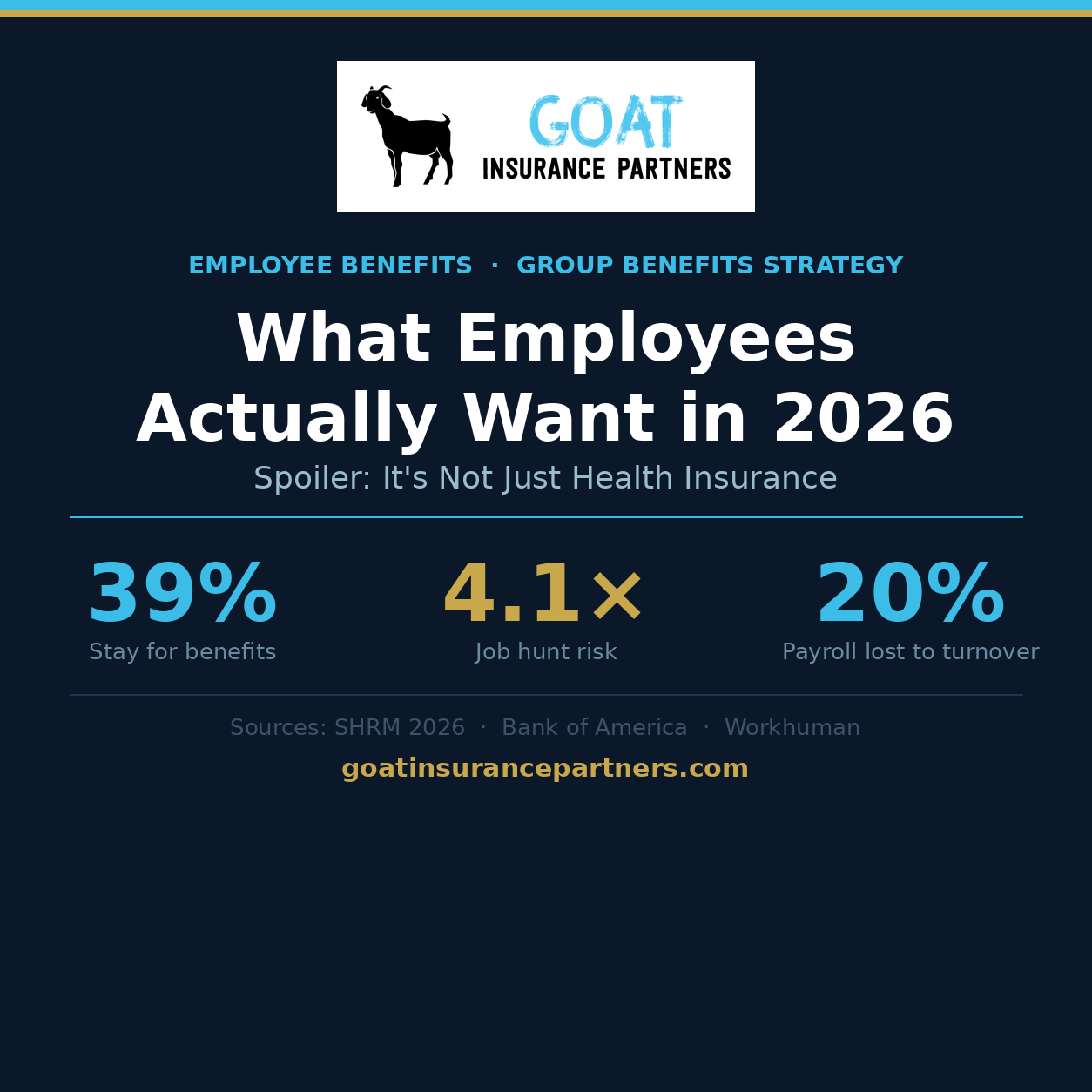
The answer, for a lot of companies, is no. Voluntary turnover costs up to 20% of payroll annually — and benefits gaps are a leading driver. Here’s what employees say they actually want in 2026, according to SHRM and Bank of America research.
1. Mental Health Coverage That Actually Functions
This isn’t a nice-to-have anymore. According to SHRM’s 2026 Employee Benefits Survey, 92% of employees say mental health coverage is non-negotiable when evaluating a benefits package. But access isn’t the whole story — network depth matters. A mental health benefit that lists 200 providers but can’t get someone an appointment within three weeks isn’t a benefit. It’s a checkbox.
Employers who are doing this right are evaluating their mental health networks for actual availability, not just headcount, and adding EAP (Employee Assistance Program) layers that give employees real, immediate access — not a 1-800 number.
2. Financial Wellness That Shows Up in the Paycheck
Bank of America’s 2026 Workplace Benefits Report found that employees under financial stress are 4.1 times more likely to be actively job hunting. The fix that actually moves the needle isn’t another brochure — it’s real money showing up in their paychecks. And that’s where smart plan design quietly wins for everyone.
Pre-tax plans done right can save a company thousands — often tens of thousands — in payroll taxes every year, while putting more take-home pay in employees’ pockets at the same time. Lower taxable wages mean lower FICA for the employer and a bigger net paycheck for the worker. That’s the rare win-win: the savings can make adding or upgrading benefits financially possible without raising the budget.
The payroll angle: Pre-tax benefit elections run through a Section 125 plan reduce employees’ taxable wages — lowering FICA on both sides of the ledger. Done right, your benefits stop being a cost line and start helping to fund themselves.
3. Choice and Personalization
SHRM’s 2026 survey found that employees in multi-generational workplaces have sharply different benefit priorities. A 28-year-old and a 52-year-old are not evaluating your benefits package the same way. One wants student loan help and flexible mental health access. The other wants robust disability coverage and executive life insurance options.
The answer isn’t one mega-plan that tries to cover everything. It’s a voluntary benefit layer that lets employees customize around a solid core. Accident insurance, critical illness, hospital indemnity, and supplemental life are all employee-paid, which means they expand the package without expanding the employer’s premium line. Done right, this turns your benefits into a genuine competitive differentiator — something candidates notice before they ever walk through the door.
4. Family and Caregiving Support
SHRM data shows parental leave offerings climbed 7 percentage points to 46% of employers in the last survey cycle, with maternity leave at 44% and family leave at 36%. These numbers are moving because employers are learning what the research confirms: caregiving support is one of the highest-retention benefits available, particularly for employees between 30 and 45.
For Florida employers competing in hospitality, healthcare, and professional services, this is an area where a targeted upgrade — even an additional two or three weeks of parental leave — can separate your package from the field without significant cost impact.
5. Transparency at Enrollment
Employees are reading the details now in a way they weren’t five years ago. SHRM notes that time spent on benefits evaluation during open enrollment has increased across all employee segments. They’re comparing networks. They’re asking what the deductible actually means. They’re looking at out-of-pocket maximums.
That means the way you communicate benefits matters as much as the benefits themselves. Employers who invest in plain-language enrollment guides and one-on-one decision support — especially for employees buying benefits for the first time — see higher adoption, fewer complaints, and stronger satisfaction scores at renewal.
Benefits Aren’t Overhead. They’re Compensation.
The employers who treat benefits as a strategy — not a vendor relationship — are the ones winning the talent game right now. They’re not just buying a group health plan. They’re building a package that keeps their best people, helps close new hires, and uses the payroll cycle as a financial lever.
At GOAT Insurance Partners, we work for you, not the insurance company. That means strategy, data, and options — not just a quote.
Key Takeaways
- 39% of employees say benefits are the primary reason they stay at a job (Bank of America, 2026).
- Financially stressed employees are 4.1× more likely to be job hunting — and financial wellness benefits directly address that risk.
- Mental health coverage is non-negotiable for 92% of employees — but network depth and real access matter more than plan inclusion.
- Pre-tax plan design can save employers thousands in payroll taxes while raising employees’ take-home pay — often making new benefits self-funding.
- Voluntary benefits let employees personalize their package without adding employer premium cost.
- Parental and family leave is now a retention differentiator, especially for 30–45 year-old employees.
- How you communicate benefits at enrollment matters as much as what the benefits are.
For Agents & Brokers: Bring Your Clients the Whole Strategy
Everything above is what your clients are weighing right now — and it’s a lot to deliver off one carrier’s shelf. If you’re an independent agent or broker, you built the relationship. You shouldn’t have to risk it because you can only bring one or two lines to the table while the full strategy walks in behind someone else.
You don’t have to build that stack yourself. At GOAT Insurance Partners, we partner with independent agents and brokers to establish the full lineup under your relationship — medical, voluntary, pre-tax wellness, MEC, and PPO dental and vision. You keep the relationship; we bring the platform behind it, so you show up as the complete benefits strategy, not a single product.
Want to add these lines of business and become the whole answer for your clients? Let’s talk: 904-788-6555 or david@goatinsurancepartners.com.
Sources: SHRM 2026 Employee Benefits Survey; Bank of America 2026 Workplace Benefits Report; Workhuman employee retention research.